| |
 | | Step
Five: Rinse Grains/Lauter/Sparge/Mash outLauter/Sparge/Mash out |
|   |
 | |
So now that 90 minutes have passed and the mash completed, its time to
extract the sweet wort from the mash tun and move it into the brew pot. This
process should take about as long as the mash. The idea here is to add 175
F water to the top of the grain bed while the flow valve is opened a small
amount. The water flows through the grain bed, collects the sweet wort, is
filtered through the manifold system and deposited in the brew pot as the total
sweet wort, ready for boil. Here's the specifics: Heat more water in the turkey
fryer pot to 180 F. At the end of the mash, open the lid of the tun and lay
a small plate/lid/bowl on the grain bed to prevent the pouring action from
disturbing the even bed. Pour the heated water onto the lid until a few inches
are gathered as the flow valve is opened a small amount. First allow a trickle,
and then open a little more. These "first runnings" will contain bits of husk.
Collect the first gallon or so of the sparge into a separate container and
recirculate by pouring over the lid on the grain bed. Once the runnings are
relatively clear, collect them in the brew pot. Continue to lauter until the
appropriate gallon level is reached. Refer to Palmer's "How To Brew" concerning
flow dynamics, mashing techniques, temperatures, enzymes and proteins.
 |
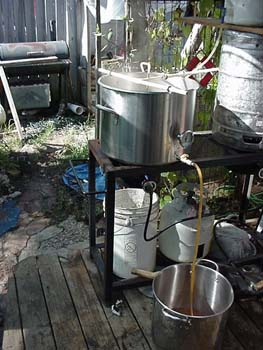
1. When the mash is done, the sparge water
should be at 175 degrees F. Place the sparge water into the hot liquor
tank and hoist it up to the highest level possible, ideally three feet
or so above the mash/lauter tun. Place the boiling kettle on the lowest
level, below the mash/lauter tun. |
|
2. Set up the sparging sprinkler
on top of the mash/lauter tun, and run a tube from the hot
liquor tank to the sparging sprinkler. |
|
 |
|
|
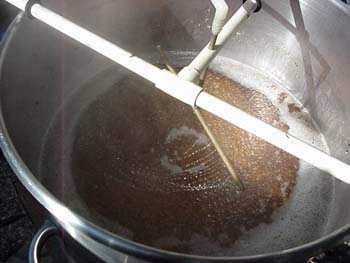
3. Open the drain of the mash/lauter
tun and slowly fill the lauter tun. The idea is to let wort
out slowly and fill with fresh water with out disturbing the
grain bed. With practice this becomes an easy operation. Maintain
about 1/2 of inch of water above the grain bed and continue
untill the run off is clear. |
|
 |
|
|
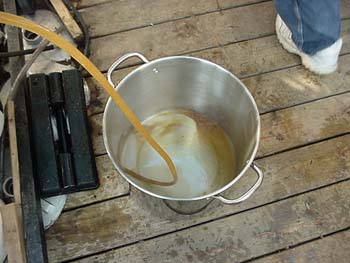
4. Start draining the wort slowly
into the boiling pot. When the liquid level of the mash falls
just beneath the top of the grain bed, start sparging: start
draining the sparge water through the sparge sprinkler into
the mash tun to replace the wort going into the boiling kettle. |
|
 |
|
|
5. During the sparge process, fiddle with the
two drains so that the sparge water coming in replaces the wort going out.
Keep the water level even with the top of the grain bed. |
|
6. Keep sparging until you're out of sparge
water or the boiling kettle is full (5-6 gallons, depending on your stove's
heating ability) |
|
7. When the sparge is pretty stable, sterilize
the primary fermenter and its lid, the airlock, and the stopper, and a
big old spoon, and whatever container you're going to use to get the wort
for the hydrometer reading |